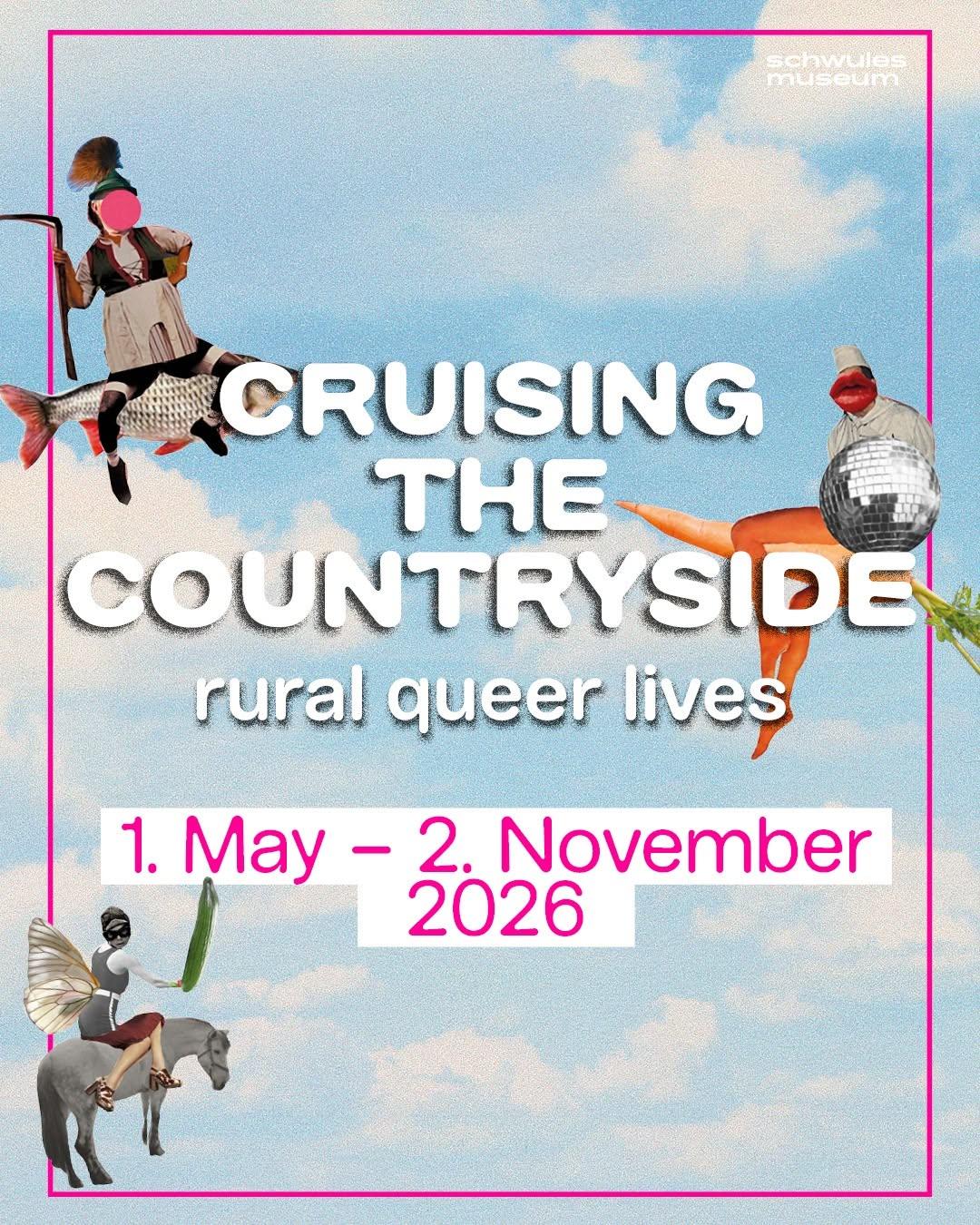
Exhibition in Schwules Museum
The villages of Brandenburg host Pride parades, while couples lock lips in fields between the cabbages and turnips, queens sashay down the farm tracks in high heels, queers genderbend farming fields and the rest area behind the highway is a prime cruising spot.
There has always been queer life in the countryside: in the 1920s, lesbian women sought out like-minded companions in the provinces, it gets homophile for Father’s Day in the 1950s, in the 1980s, women and lesbians gathered in the Hunsrück mountains to protest against war and patriarchy and in the 1990s the magazine PROvinz reported on lesbian and gay life in Neubrandenburg. Today, education about TIN lives has found its way into classrooms in eastern Saxony, and LGBTIQ+ people are reclaiming the field of agriculture.
The realities of life in the countryside are as complex as the people who live there. CRUISING THE COUNTRYSIDE – RURAL QUEER LIVES takes us on a walking tour through small towns, farms, and remote villages, offering insights into LGBTIQ+ activism, communities, and utopias. While most of this journey spans a period from the 1970s to the present day, we also take a few forays back to the 1920s.
The mountains are home to queer communities, associations, and solidarity. The islands, surrounded by rough seas, tell stories of isolation and solitude. The mixed forests are hybrid spaces where the countryside meets the city, where farmland meets the surrounding villages and small towns. The unruly scrubland of the heath nurtures dreams of nature and fantasies of village life. And the wide-open spaces of the Brandenburg Lake District foster a rich diversity of queer activism.
The exhibition CRUISING THE COUNTRYSIDE – RURAL QUEER LIVES showcases historical materials from the archives of the Schwules Museum which shows rural lives and LGBTIQ+ activism. Other items on loan show manifold queer initiatives and while new video interviews with people from Brandenburg reflect the many colours of their lived realities. The exhibition is framed by historical materials and contemporary artworks that explore barnyard vibes, mountain blues, pastoral creativity, and provincial kings.
Curated by Collin Klugbauer
With artworks and contributions of, i.a.:
Anja & Marion, AIDS-Hilfe Lausitz e.V., Akademie Waldschlösschen, Alizé Rose-May, Arruda Collective, Bert, Cécil Ludwig Röski, CSD Angermünde, CSD Bad Belzig, CSD Bernau, CSD Cottbus/Niederlausitz, CSD Schwedt/Oder, CSD Eberswalde, CSD Neuruppin, CSD Ludwigsfelde, CSD Teltow-Fläming, Dykes on Bikes® Rhein-Weser WMC, Emanzipatorische Landwirtschaftsnetzwerk ELAN, Ezra, FFBIZ – das feministische Archiv, Forum Queeres Archiv München e.V., Gerda Rotermund, Gerede e.V. (Verein für sexuelle und geschlechtliche Vielfalt in Dresden) / Anina Falasca, Liam S. Rogall, Robin Raphael Penzkofer, George Platt Lynes, Gay-Stammtisch-KW, Gunny Catell, Harry Hachmeister, Hexenring, Jasmin, Hollerhof, Jan Eilhardt, Jonas Löschau / CSD Bautzen, JoVe & Co. e.V., Jürgen Wittdorf, Kai* Brust in Kooperation mit Educat Kollektiv e.V., Karla & Míro, Klaus-Dieter Begemann, Gärtnerei Kraut & Blüten K. Oechsler, Landesverband AndersARTiG, Landwirtschaftskollektiv der Kommune Niederkaufungen, Lena-Rosa Händle, lila_bunt-Kollektiv, Lili-Elbe-Bibliothek, Ludwig von Hoffmann, Maria Finnemann, Muerbe und Droege / Haus des Wandels, Pancho Assoluto, Papas vom Dorf, Rabelades Farm, Regenbogenkombinat Cottbus, Regenbogen-Treffpunkt Guben, Regenbogen-Treffpunkt Spremberg, Renée Sintenis, Robert-Havemann-Gesellschaft, Schwuhplattler, SOLAWI Isartal eG, Słubice-Frankfurt-PRIDE, Therese Koppe, Tomka Weiß & Ärzte ohne Ängste (Martina Kock, Panda Ortmann, Jamie Janicek, Jascha Schenk, Britta Scholl, Tomka Weiß), Trans*communitytreff Niederlausitz, Tucké Royale, Queer Bikes Berlin, queerlich & Kulturort in der fünf, Queer Café im Horte, Queeres Netzwerk Neuruppin, Queerer Jugendtreff Schiltach, Queermonics, 3erH0f.
Visual: Studio Erika